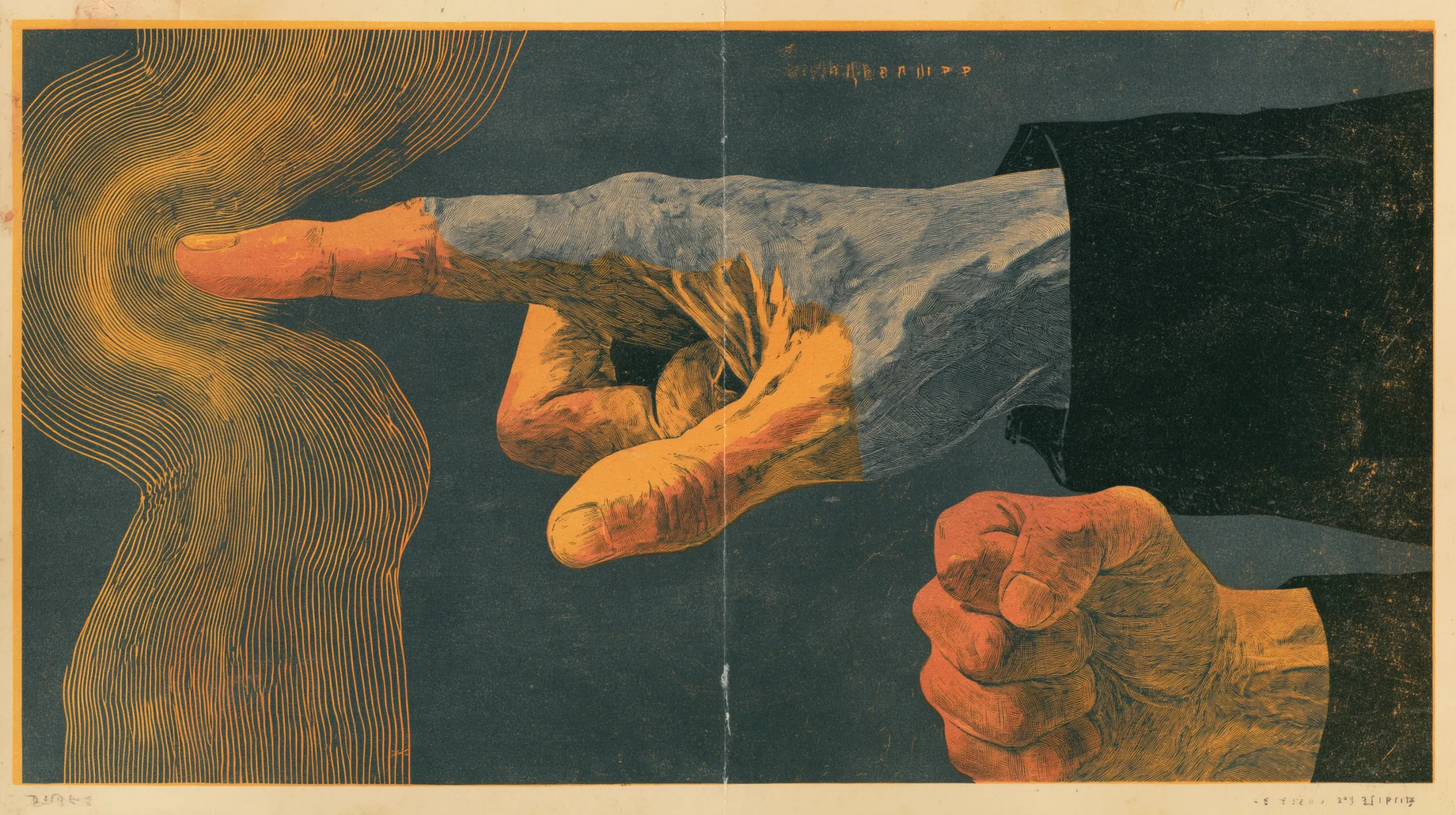
Politics is angry because most people are working harder than their parents did and still falling behind, and nothing in their daily life shows them what’s causing it.1 When people feel robbed but can’t see the thief, they turn on each other. The anger is real and it’s rational. It’s mostly aimed at the wrong target.
The mechanism underneath
Technology keeps making things cheaper to produce, because better tools let the same work create more output. Where money can’t be created at will, that saving reaches you as falling prices for most goods and services. Your savings then buy more over time. You can see it in the corners of life the money system doesn’t dominate. Your phone does what a camera, a map, a stereo, and a torch used to do, for close to nothing.
But our money is built on debt. Most new pounds come into existence when someone borrows [when a bank makes a loan, it creates the deposit it lends out], and those debts are fixed in pounds.2 That matters when prices fall. A system built on debt can take a slow fall that comes with better tools. In that fall it’s the cost of making things that drops, and pay drifts down slowly behind it, so the money to meet a fixed payment is still there. What it can’t take is a sudden fall in the prices credit pushed up, houses first, because then the losses spread through the banks. In that fall it’s the lending that has stopped, so incomes and the house fall together and at once, and the fixed payment is hit from both sides in the same year. Houses come first because people buy them with borrowed money. The debt takes a bigger bite of every income. And where the loan was written against a house, the house is worth less too, so the bank stands to lose more on that loan. So every time a sudden fall in those prices threatens, the system is rescued with new money, and the rescues keep getting bigger.
In between, policy targets rising prices of about 2% a year, forever.3 Central banks publish why they aim there. They want room to cut interest rates in a downturn, they know wages resist falling, and they say the official measure of prices overstates the rise.4 Those are the reasons they give, and the debts aren’t among them. The debts show up in the rescues, not in the everyday 2%. Getting there takes new money that first cancels the fall better tools would have delivered, and then adds two on top. Governments and central banks create that money and credit to push prices up.5
That new money doesn’t arrive evenly. It reaches financial markets first, so house and share prices jump quickly.6 Wages move last, because pay gets renegotiated slowly, maybe once a year (that order has a name, the Cantillon effect, whoever receives new money first benefits before prices adjust for everyone else).7 So over a stretch, people who own assets get richer in pound terms while people who live on a payslip find their pay buys less. In Britain since 2008 that’s what the figures show.8 That’s what happens when money is created faster than productivity grows. Pay rarely catches up in full, so the gap builds over years. Rising prices and falling real wages are the same event seen from two sides. Technology made things cheaper to produce, you worked just as hard, and you didn’t get the saving as a lower average price. Part of it reached you as higher pay, late and unevenly.9 The rest went to whoever got the new money first, through house and share prices. Working harder than your parents did is what chasing that missing saving looks like.
Why that comes out as anger at each other
The loss is real but invisible. Nobody’s payslip shows a line called “transferred to asset owners”. People just feel the results. Rent up again. The food shop dearer. The deposit further away year after year. So they look for someone to blame, and the visible candidates are other people. The landlord, the boss, the banker, the immigrant, the boomers, the other party’s voters. Some of them even gain from the transfer. None of them built the machine. A few do touch rules that bear on what people pay. The biggest banks help write the money’s rules, and homeowners who vote in local planning help set what housing costs.10 Housing supply rules are a second real cause of the anger, and anger aimed there isn’t misdirected.
Scarcity makes groups fight. At a summer camp in the 1950s (the Robbers Cave experiment), researchers split boys into two groups and put them in competition over scarce resources.11 The groups turned hostile fast. History outside the lab shows the same pattern. Given a shared goal that needed everyone, the hostility faded. Our money system takes the price falls technology would deliver and replaces them with rising costs in the things people must buy, housing most of all, which manufactures the feeling of scarcity in the most productive era so far. Part of the rise in care, health, and education would have happened under any money, because better tools have changed those jobs less. That manufactured scarcity is why the anger feels so out of proportion. People can sense the abundance exists and can’t reach it.
Why politics feeds the anger instead of fixing it
Where the currency still works, the honest deal doesn’t get offered, election after election. Imagine the honest pitch. “Your pay will go from £50,000 to £48,000, but your costs will fall by more, so you’ll be better off.” Voters hear the £48,000 and choose the candidate promising £52,000, even though the first deal wins. We’re used to judging pay by the number, not by what it buys. People living with an unstable currency learn sooner to ask what the number buys, because they have to. Where the currency has visibly failed, the honest deal does get offered, and it can win. Where the currency still works, that’s a standing bias in what gets offered, not a guarantee that an honest candidate loses a given election.
So the parties compete on promises of relief. Subsidies, transfers, rent caps, and help-to-buy schemes.12 Most of those promises are paid for by borrowing, because the sums run past what taxes raise. Time and again the central bank has ended up buying a large share of that debt with new money.13 It buys from existing holders, so the new money reaches them first and lifts asset prices before it reaches pay.14 That reopens the gap the relief was meant to close, even where the relief raised incomes at the bottom while it lasted.15 Election after election, the divide compounds, and each side becomes more certain the other side is the problem. The one thing never on your ballot paper is the money system itself.
Media and social platforms then pour fuel on the anger, because outrage holds attention and attention is what they sell. But the feed isn’t what made people’s pay buy less. What it takes is their attention. The falling behind is real. What the money system does is take the saving that technology would otherwise have delivered as falling prices. The money system isn’t the only force pressing on people’s pay. Automation and global wage competition push the same way, and fixing the money doesn’t stop either of them.16 Economic stress makes tribes. The feed just sorts people into one of them.
Where it goes if nothing changes
Toward control. A system that keeps mass-producing losers has to manage them, so you get more surveillance of money and speech, and emergency powers that don’t expire. The worst historical version is Germany in the 1920s, where printing destroyed savings, and a decade later, with the worldwide slump on top of it, people hunted for someone to blame and a strongman offered them targets.17 I’m not predicting that. I’m saying the direction of travel is set by the incentive, not by the character of whoever’s in charge.
The arguments that point away from the money
“Anger has many causes: culture, education, social media, immigration.”
True, and they matter. But the money pressure reliably deepens the fault lines people already have, because it makes life feel zero-sum, and people fight harder over their differences when they feel they’re falling behind. That’s a tendency, not a certainty, and measured political hostility hasn’t risen together across rich countries.18 Social media is petrol. The money system is the match.
“Redistribution will fix the divide.”
Inside this system, relief on this scale is paid for by borrowing rather than out of taxes. Some of that borrowing is taken up by savers, which moves money that already exists. Time and again, the rest has been bought by the central bank with new money.19 Year after year the sums run past what taxes do raise, and no tax rate pays off the debt those promises have already run up.20 Growing the economy faster than that debt is a different thing, and it does help. But when technology keeps pushing prices down and the debts are this large, the path governments lean toward is paying those savers less than prices rise, so the debt is repaid in pounds that buy less. The gap reopens after each transfer, because the new money reaches asset owners before it reaches pay. Tax fights attack the effects while the mechanism keeps widening the gap. Politics can blunt the worst of it at the margins. Politics inside this system hasn’t stopped the transfer, because the lever, the power to create money, stays with the people who write the rules. Parliaments have rewritten the monetary rule more than once.21 What no rewrite has done is take away the power to rewrite it, and a promise not to pull a lever isn’t the same as removing it. While the lever stays, a change of government changes who benefits and leaves the transfer itself running. That’s a big part of why decades of redistribution haven’t closed the divide.
“Politics was ever thus. This is just tribalism.”
Tribalism is ancient, but whether tribes fight tracks how zero-sum life feels. Money outranks the law, because it shapes what laws get written and who they serve. Fix the base and the same tribal instincts have far less to feed on.
“Bigger government is a choice, not monetary fallout.”
It looks like a choice. Follow the incentive underneath it. When the money system pushes rents, food, and deposits up year after year, voters demand relief from rising costs, and politicians respond with new programmes. The one who refuses is the one offering £48,000. Debased money creates the pain that makes the expansion politically inevitable. Fix the money and the pain that feeds the expansion drains away.
Where it goes if the base gets fixed
Whoever wins the shouting match inside the system, the way out is still fixing the base, which means money nobody can create more of, so productivity reaches everyone as falling prices. Do that and saving works again, the hidden transfer stops, and the manufactured scarcity drains out of politics. Fixing the base doesn’t stop automation or global wage competition. What it changes is who ends up with the saving. Once prices are free to fall, that saving reaches people as cheaper goods and more free time, which cushions the change instead of leaving them a pay packet that buys less. That’s where bitcoin comes into this story. Its role here is the neutral base that lets abundance reach people, not a trade to be in. That holds only while it stays decentralised and secure, and only if people use it as money rather than just hold it. It’s also the kind of shared goal that ended the hostility at the camp. People who agree on nothing else can agree on rules nobody can bend. When someone can feel life getting cheaper over time, they need someone to blame far less.
Anger is a stage. When people first see the transfer, they’re furious, and that’s better than not seeing it. But it’s a rung on a ladder, not a place to live.
Sources 21
What this essay rests on, as checked on 7 October 2026.
- 1 National Bureau of Economic Research, The Fading American Dream: Trends in Absolute Income Mobility Since 1940: "We find that rates of absolute mobility have fallen from approximately 90% for children born in 1940 to 50% for children born in the 1980s." The source measures the share of children earning more than their parents, and 50% is about half rather than most; it reports income relative to parents, not hours worked or working harder.
- 2 Bank of England, Quarterly Bulletin 2014 Q1, “Money creation in the modern economy”, published 14 March 2014: "the majority of money in the modern economy is created by commercial banks making loans"
- 3 Federal Reserve, Statement on Longer-Run Goals and Monetary Policy Strategy, 25 January 2012: "The Committee judges that inflation at the rate of 2 percent, as measured by the annual change in the price index for personal consumption expenditures, is most consistent over the longer run with the Federal Reserve's statutory mandate." European Central Bank, Press release, 8 July 2021, "ECB's Governing Council approves its new monetary policy strategy": "The Governing Council considers that price stability is best maintained by aiming for a 2% inflation target over the medium term. This target is symmetric, meaning negative and positive deviations of inflation from the target are equally undesirable." Bank of England, Inflation and the 2% target: "The Government sets us a 2% inflation target"; "If we miss the inflation target by more than 1 percentage point either side of the target, we must tell the Government why."
- 4 European Central Bank, An overview of the ECB's monetary policy strategy, 2021: "Three additional factors ... call for a sufficient inflation buffer": "downward nominal wage rigidities", "measurement bias", and room for "interest rate cuts". The target "underlines the ECB's commitment to providing an adequate safety margin to guard against the risk of deflation". Bank of Canada, Renewal of the Inflation-Control Target: Background Information, November 2011: "In addition to the risks associated with the ZLB, two other potential costs of moving to an inflation target lower than 2 per cent were identified": "measurement bias in the CPI and downward nominal wage rigidities". The Bank adds that it views neither of those two as a significant impediment to a lower target.
- 5 Bank of England, Quarterly Bulletin 2014 Q1, "Money creation in the modern economy": "The amount of money created in the economy ultimately depends on the monetary policy of the central bank." ... "The central bank can also affect the amount of money directly through purchasing assets or 'quantitative easing'."
- 6 Bernanke and Kuttner, "What Explains the Stock Market's Reaction to Federal Reserve Policy?", NBER Working Paper No. 10402: "equity prices respond within the day to the unanticipated component of monetary policy actions"; "The data are daily returns on the S&P 500 index from January 3, 1989 through December 31, 2002."
- 7 Cantillon, Essai sur la Nature du Commerce en Général, Part II, Chapter VI, "Of the increase and decrease in the quantity of hard money in a State": "the Proprietors of these Mines, the Undertakers, and all those who work there, will not fail to increase their expenses in proportion to the wealth and profit they make". The page carries nothing on prices adjusting afterwards for everyone else.
- 8 Office for National Statistics, Average weekly earnings in Great Britain: March 2020: "In real terms, regular pay fell to £471 per week and is back below the pre-2008 economic downturn peak"; "£2 (0.4%) less than the pre-2008 economic downturn peak of £473 per week for March 2008." This is one comparison, for January 2020, not a series across the years since 2008.
- 9 Stansbury and Summers, "Productivity and Pay: Is the link broken?", NBER Working Paper 24165, 2017: "over 1973-2016, one percentage point higher productivity growth has been associated with 0.7 to 1 percentage points higher median and average compensation growth"; "other factors orthogonal to productivity have been acting to suppress typical compensation". Pessoa and Van Reenen, "Decoupling of Wage Growth and Productivity Growth? Myth and Reality", Centre for Economic Performance Discussion Paper 1246, October 2013: UK, 1972 to 2010: "real productivity grew by 114 per cent" and "median real wages by 72 per cent".
- 10 Igan and Mishra, "Wall Street, Capitol Hill, and K Street: Political Influence and Financial Regulation", Journal of Law and Economics, 2014: "spending on lobbying by the financial industry and network connections between lobbyists and legislators were positively associated with the probability of a legislator changing positions in favor of deregulation"; the database covers "the financial industry from 1999 to 2006". Hilber and Vermeulen, "The Impact of Supply Constraints on House Prices in England", Economic Journal, 2016: "regulatory constraints have a substantive positive impact on the house price-earnings elasticity", from "a unique panel dataset of 353 Local Planning Authorities in England between 1974 and 2008". The finding is on the house price-to-earnings elasticity, not a share of price levels.
- 11 Sherif, Harvey, White, Hood and Sherif, Intergroup Conflict and Cooperation: The Robbers Cave Experiment, chapter 4, “Experimental Formation of In-groups Revealed Through Appropriate Attitudes and Behavior” (1954/1961): “Two groups of subjects were kept apart during Stage 1. Until the last days of that stage, at no time did the groups have contact with one another.”
- 12 Scottish Parliament, Cost of Living (Tenant Protection) (Scotland) Act 2022, Explanatory Notes: “On or after 6 September 2022, a landlord under a Scottish secure tenancy or short Scottish secure tenancy may not increase the rent payable under the tenancy by more than the permitted rate, which is initially set at 0%.” HM Treasury, Spring Budget 2023: “additional Cost of Living Payments for more than 8 million households on means-tested benefits, 6 million people on disability benefits, and 8 million pensioner households”. The page does not mention Help to Buy.
- 13 Bank of England, Asset Purchase Facility Quarterly Report, 2021 Q4: “As at 31 December 2021, the Bank had reported cumulative asset purchases net of sales, redemptions and repayments totalling £894.7 billion.” The page prints no fiscal support figures.
- 14 Bank of England, The Distributional Effects of Asset Purchases, 12 July 2012: “the Bank's asset purchases have increased the prices of a wide range of assets, not just gilts.”
- 15 United States Census Bureau, Supplemental Poverty Measure report, “Poverty Measure That Includes Government Assistance Increased to 12.4% in 2022, When Pandemic Relief Ended”: “The Supplemental Poverty Measure (SPM), which includes government assistance, increased to 12.4% in 2022 from 7.8% in 2021,” the rise “largely the result of the end of stimulus payments and tax credits”.
- 16 Acemoglu and Restrepo, “Robots and Jobs: Evidence from US Labor Markets”, NBER Working Paper No. 23285 (Journal of Political Economy, 2020): “We analyze the effect of the increase in industrial robot usage between 1990 and 2007 on US local labor markets... we estimate large and robust negative effects of robots on employment and wages across commuting zones.” Autor, Dorn and Hanson, “The China Syndrome: Local Labor Market Effects of Import Competition in the United States”, NBER Working Paper No. 18054 (American Economic Review, 2013): “We analyze the effect of rising Chinese import competition between 1990 and 2007 on local U.S. labor markets”; it “increases unemployment, lowers labor force participation, and reduces wages in local labor markets.”
- 17 Deutscher Bundestag, “Hyperinflation in Deutschland 1923”: “Die Hyperinflation traf vor allem Arbeiter, Kleinrentner und Kriegsversehrte sowie Sparer aus dem mittleren und wohlhabenden Bürgertum, die durch die Inflation regelrecht enteignet wurden”; 4.2 trillion marks per US dollar at the November 1923 peak.
- 18 Boxell, Gentzkow and Shapiro, “Cross-Country Trends in Affective Polarization”, NBER Working Paper No. 26669, January 2020: “We measure trends in affective polarization in twelve OECD countries over the past four decades... the US experienced the largest increase in polarization. Five countries experienced a smaller increase in polarization. Six countries experienced a decrease in polarization.”
- 19 Bank of England, Asset Purchase Facility Quarterly Report, 2021 Q3: Facility set up 29 January 2009; gilt purchases expanded by £200bn (19 March 2020), £100bn (18 June 2020) and £150bn (5 November 2020) to a £895bn target stock; £855.6bn cumulative purchases at 29 September 2021.
- 20 Office for National Statistics, UK Perspectives 2016: Trends in the UK economy: "Government expenditure has been larger than government income for most years since 1980, which is why the UK has typically been in deficit since 1980." The page says most years, not every year. ONS, Public sector finances, UK: April 2026: "Borrowing – the difference between total public sector spending and income"; for the financial year ending March 2026, receipts £1,232.10 billion against spending £1,362.80 billion. The bulletin gives that one year, not a run of years.
- 21 Parliament of the United Kingdom, Bank of England Act 1998, section 12: Specification of matters relevant to objectives: "The Treasury may by notice in writing to the Bank specify for the purposes of section 11—(a)what price stability is to be taken to consist of", and "at least once in every period of 12 months". Congress of Argentina, Ley 25.561, Emergencia Pública y Reforma del Régimen Cambiario, sanctioned 6 January 2002: "Deróganse los artículos 1°, 2°, 8°, 9°, 12 y 13 de la Ley N° 23.928" (Article 3); sanctioned 06-01-2002, published in the Boletín Oficial 07-01-2002.