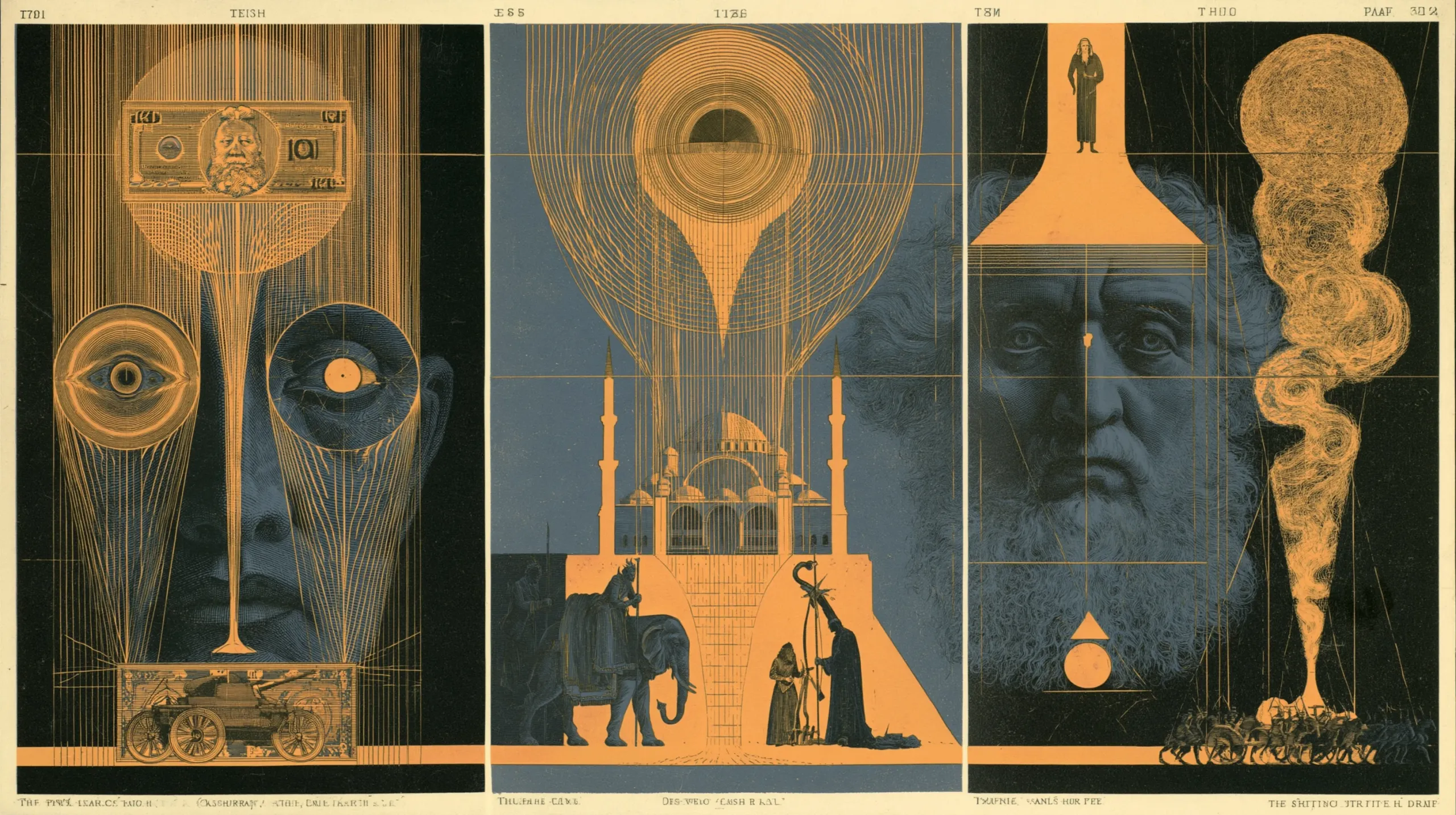
One decision can cut every wage and every saving in a country at once. Nobody votes for it and nobody negotiates it. The damage doesn’t stop at that country’s border. The same power that cuts wages at home pays for wars abroad, and it never sends the bill up front.
That decision is a devaluation, a pay cut imposed on a whole country at once, and the same stroke makes the country’s goods cheaper for foreigners. Those cheaper goods take orders and jobs from workers in other countries.1 Those countries carry debts fixed in money terms, and their politics rewards promises funded by more money over letting prices and pay fall, so absorbing the hit costs the government that chooses it. The moves that answer it, cutting their own currency in reply, holding wages down at home, taxing money coming in, buying foreign currency to hold their own currency down, or tariffs [taxes on imported goods], all leave the adjustment with somebody else. Holding wages down does the same job as cutting the currency, because cheaper labour makes the country’s exports cheaper, and those exports still take orders from workers somewhere else. Every defensive move injures the next country, so the moves multiply. That’s the staircase. A devaluation, a round of devaluations in reply, and a trade war are the moves a currency fight runs through. Each country picks the move it can reach, and the fight as a whole still climbs. History shows this path often ending in a shooting war, and the 1930s are one decade of that record. A shooting war is where the fight can end, though it doesn’t have to.
Then printing pays for it. A war eats real things. Someone must hand over the labour, the steel, the fuel, and the food. If the bill arrives as a visible tax, citizens weigh the war against it, and the war has to keep earning its keep. If the government and central bank create new money to cover the bill, the cost still lands on citizens, but it arrives a year or more later, spread across every shopping basket, with no label on it. Hiding the bill lowers the political price of starting a war and cuts the feedback that would end one. That’s the whole trick, and it’s centuries old.2
The mechanism is the same one the rest of the argument runs on. Our money is built on debt, and those debts are fixed in money terms.3 A system built on debt can take a slow fall that comes with better tools. In that fall it’s the cost of making things that drops, and pay drifts down slowly behind it, so the money to meet a fixed payment is still there. What it can’t take is a sudden fall in the prices credit pushed up, houses first, because then the losses spread through the banks. So every time a sudden fall in those prices threatens, the system is rescued with new money, and the rescues keep getting bigger. In between, policy targets rising prices of about 2% a year, forever.4 Central banks publish why they aim there.5 Getting there takes new money that first cancels the fall better tools would have delivered, and then adds two on top. Either way, governments and central banks hold a lever that changes the value of everyone’s money without asking them. Most of the time they pull it to keep prices rising, so you don’t get the saving as a lower average price. Part of it reaches you as higher pay, late and unevenly, and the part that doesn’t goes to whoever got the new money first, through house and share prices. In wartime the same lever funds the war. Money outranks law. When a state can fund itself by diluting the currency, your consent becomes decorative on its biggest decisions, and war is the biggest.
How one country’s devaluation becomes everybody’s trade war
A devaluation does its first damage at home. When a government cuts its currency’s exchange rate, everything imported jumps in price at once, and every wage and every saving in that currency buys less. Nobody negotiated a pay cut with a single worker, but every worker got one. Zimbabwe is the cleanest recent example of that first damage. It launched a new currency in April 2024 with gold and foreign reserves behind it. Within six months the central bank cut that currency’s official value by 43% in a day, from 13.9 to 24.4 against the dollar. The reserves didn’t stop the cut, because the people holding them also set the rate. On the long-term exchange rate chart a devaluation shows up as a cliff rather than a slope, because someone decided it that day. Where a currency floats, the cut is slower and comes through interest rates and money creation instead of a decree. The direction and the victim are the same.
Why would a government do that to its own people? Debt and jobs. A country loaded with debt carries it fixed in money terms, and its politics rewards promises funded by more money over an accepted fall, so letting prices and pay fall costs the government that chooses it. And a devaluation is the fastest way to make its workers cheaper to the rest of the world without a single wage negotiation. Exports get cheaper abroad, order books fill for a while, and the government calls it restoring competitiveness. Strip the euphemism and it’s a mass, involuntary wage cut that would never pass a vote if proposed as a wage law.
Say you’re the government next door. Your competitor’s goods just got cheaper in your own market. Your factories lose orders through no fault of their own. And you’re carrying the same debts, fixed in money terms, and the same politics, so absorbing that hit costs you. You have three options. Accept the job losses, which puts the whole hit on your own workers and is politically fatal. Devalue your currency to match, which cuts your own citizens’ wages and passes the problem to a third country. Or put up tariffs, which raises prices for your consumers and invites retaliation. There are less visible moves too, holding your own wages down, taxing money coming in, or buying foreign currency to hold your own currency down, and each of them leaves the adjustment with somebody else as well. Every option hands the pain to somebody else, because the move that started it wasn’t creating anything. One country grabs a bigger slice of world demand by cutting its people’s wages. Notice you didn’t need a villain to get here. You inherited the debts and the politics, and the least bad move on your desk still injures somebody abroad. Everyone in this story is doing the reasonable thing from where they sit. The staircase doesn’t need bad people. It only needs the lever.
That’s why it escalates rather than settles. When a government can change what its own money is worth, it holds a lever that forces every other government’s hand. Economists call the result competitive devaluation, a race where each country cheapens its money to defend exports, and each round leaves everyone’s savings in those currencies worth less. When every state is cheapening its currency to keep jobs, the friction between them grows and protection follows. A country with its own currency cuts it. A country without one, or one that won’t cut, reaches for tariffs and quotas instead.
Tariffs shrink trade.6 Shrinking trade raises the price of real things, and where that rise lands it feeds us-versus-them politics inside a country. Protection creates shortfalls, and essentials feel scarce. Groups made to compete over scarce resources turn hostile, inside a country and between countries alike. That resource fear is a reliable accelerant of the climb from trade war to hot war. Creating new money manufactures exactly that feeling across a whole country, because more money chasing the same goods makes essentials feel rarer than they are. When trade seizes up, force becomes one of the options. The state doing the blocking is using force from the start, because a blockade is force. The blocked state’s usual answer is to find another route, and Japan in 1941, cut off from oil and unable to find one, answered with an attack within months.7
You can find every piece of that chain in the 1930s. Tariff walls went up. Countries left gold one by one, and each departure gave a brief edge and forced the next country off. The value of world trade collapsed, and the decade ended in the worst war in history. Currency war becomes trade war, and often hot war, and afterwards the winners declare a currency reset under new rules, which begins the cycle again.
Tariffs don’t even deliver what they promise, because they collide with technology. When imports get taxed, domestic firms face higher input costs while customers still demand low prices, so they automate faster instead of hiring. The trade war raises prices, sours relations between countries, and the jobs still don’t come back.
Why printing makes wars easier to start and longer to run
What a war consumes each day is set by physics and logistics, not by how it’s paid for. What the funding choice decides is who hands those resources over, whether they can see themselves doing it, and how many days the war goes on. A government has three ways to raise the resources. It can tax now, it can borrow, or it can create new money. Everything about a war’s politics flows from which one you pick.
Easier to start
If war means a tax bill, the leader pays a political price on day one. Households see the deduction and know what it’s for, and attach it to the leader’s choice. The war has to clear a high bar of public conviction before the first shot. If war can be funded by creating money, the cost reaches households twelve to eighteen months later, because new money works through the economy with a lag, and it arrives as higher food, fuel, and rent prices that can be blamed on supply chains, speculators, the enemy, or anything else.8 The bar drops. Wars that could never have survived a visible bill now clear it. When leaders can push the cost onto savers without asking, aggression gets cheaper for the person deciding, and things that get cheaper happen more often.
What the hidden lever raises explains why states at war keep reaching for it, century after century. In 2019 the entire corporate profit of the United States, before tax, was about 2.4 trillion dollars.9 The country’s stock of money [cash and bank deposits together] grew by about 3.8 trillion dollars in 2020 and by more than 6 trillion over the two Covid years. Seizing every dollar of profit from every company in the country couldn’t have matched the growth in the money stock in a single year, and no one voted on the part the central bank financed. Taxes have a ceiling because people resist them. Dilution’s ceiling is only the point where people abandon the currency itself, and that’s much further away. The United States is the extreme case, because the world holds its bonds. Every state with a printing press has a smaller version of the same arithmetic.
Longer to run
Left to money, wars end through feedback. Either the public refuses to keep paying, or the treasury runs dry. Funding a war by debasement [funding the state by creating new money, which waters down everyone else’s money] cuts both of those. The public can’t refuse a cost it can’t see or trace. And the treasury doesn’t run dry, because it refills itself with new claims on the whole nation’s savings. A reserve currency issuer [the country whose money the world uses for trade and savings] can go one better and draw on foreigners’ savings too. The world holds its bonds, and the world’s savings get diluted along with everyone else’s. The long pattern is that empires fund war by issuing claims on other people’s labour, and that currency regimes backed by conquest and extraction outlive the ones that aren’t. The money funds the war and the war’s extraction props up the money. When the extraction slows, the money goes with it.
Borrowing is the case in between, and where it ends up depends on who buys the bonds and at what rate. If citizens voluntarily buy war bonds at a rate the market sets, borrowing behaves like a tax you can see and agreed to. The moment the central bank buys the bonds, or caps the interest rate by promising to buy however many it takes, borrowing collapses into printing. The bond is the costume the new money wears.
The European powers cut their currencies loose from gold within days of the First World War starting. That was one of the first things they did, which tells you what keeping honest money would have cost them. Weimar is the direct case. Germany printed to meet its obligations, the printing destroyed the middle class’s savings, and out of the wreckage people reached for the strongman, and then the next war. Debasement funded the last war, and the social breakdown it left behind invited the leaders who started the next one.
The same war, paid two ways
Paid by visible taxes
- The government chooses war and must present the bill in the same breath. A tax rise, this year, on people who can see it’s them.
- The legislature votes. Cost and decision are welded together in public.
- You see the deduction on your payslip and you know what it’s for. The war has a price tag in every household’s budget.
- Consent stays on trial. As the tax bites, people weigh the war against the bill. If it stops being worth it, pressure builds and the war must shrink or end.
- Spending can’t outrun what taxation and honest borrowing can raise, and there’s a real ceiling on both because people resist, evade, and vote. So the war must stay small, stay short, or keep proving itself.
Paid by debasement
- The government chooses war and presents no bill. It issues bonds [government IOUs].
- The central bank creates new money to buy those bonds, or holds the interest rate down by standing ready to buy. No household sees a new deduction anywhere.
- The state spends the new money first, at today’s prices, on weapons, contractors, and soldiers’ pay. The first spender of new money gets full value. That step has a name, the Cantillon effect [whoever receives new money first wins, whoever receives it last loses].
- The new money works outward through the economy. A year or more later, prices are higher for food, fuel, and rent. Wages adjust late and rarely catch up fully.
- Everyone holding the currency pays a slice. It comes out of the cleaner’s savings, the pensioner’s fixed pension, and the bonds the foreigner holds. The tax is real, but it goes by the name inflation, and the government blames the weather, the supply chains, or the enemy. The excuses change by the decade. The lever doesn’t.
- Because there’s no line item, there’s no vote, no one to hold to account, and no natural stopping point. The war draws down the whole society’s stored work, quietly, for as long as confidence in the money holds.
- If nothing else stops it, the end is a currency crisis rather than a tax revolt. Inflation accelerates, confidence cracks, and the regime resets the money under new rules, usually after the war has consumed far more than any openly funded war could have.
A day of war costs the same steel, fuel, and labour whichever way it’s paid for. What the funding changes is visibility, consent, feedback, and incidence [who actually ends up paying], and those four decide how many of those days there are. A tax-funded war has to convince you. A debasement-funded war only has to keep you from noticing. A visible tax can at least be designed, aimed at those most able to pay. The inflation tax aims itself, and it lands hardest on cash savers, pensioners, and anyone whose pay moves late, the people furthest from the new money.
What this argument has to survive
“War has many causes beyond money.”
True, and I’d never write otherwise. Human motives are tangled, and money is usually not what people are fighting over. It’s the enabler. The claim is about how often wars start, how long they run, and how a fight over currencies climbs into a fight with weapons. Money whose value a government can change without asking makes war cheaper to start and easier to sustain. The spark can come from anywhere, ambition, fear, ideology, and sometimes, as the staircase above shows, from a fight over money itself. The funding mechanism decides whether the fire can spread.
“Modern institutions prevent this escalation now.”
Institutions run on monetary incentives, and when money breaks, those incentives break with it. Those institutions don’t prevent devaluations. For an indebted country under funding stress, the standard rescue package arrives with conditions, and a devaluation is one of them, alongside subsidy cuts, tax rises, and reshaping the economy to earn foreign currency. Where the country has no currency of its own to cut, the same adjustment is asked of wages instead. On the trade side the institutions are late rather than absent. Their tariff-cutting work carried on through 1971 to 1973, the years when the dollar’s link to gold was cut and fixed exchange rates ended.10 The protection of those years moved instead into quotas and into deals where a country agreed to limit its own exports, and the body that ran the world’s trade rules didn’t cover those deals. It took until 1995 for those deals to be prohibited.
“Printing and war is correlation, not causation.”
The mechanism carries the argument without the correlation. When a leader can move the cost of aggression onto savers invisibly, aggression becomes easier for the person choosing it. You don’t need a scatter plot to see that lowering the price of something produces more of it.
“Devaluation is a legitimate tool for rebalancing trade.”
Whatever it does for exports and imports, at home it’s an unvoted pay cut on every citizen at once. If a government proposed the same thing openly as a wage law, an unvoted pay cut across every payslip and pension, imposed on Tuesday, it would never pass. Doing it through the exchange rate changes the visibility, not the substance.
What changes when the lever goes
Remove the lever and accountability rises. A government that can’t dilute must fund every project, including war, through visible taxes, honest borrowing, or savings it already holds, choices citizens can see and contest. That’s the sense in which a money nobody can print is a peace technology. It works on cost, not character. Coercion gets expensive again, because on hard money every hour of war drains the war-maker’s hoard instead of everyone else’s, and the feedback that ends wars comes back to life. Fixing money doesn’t abolish war. It re-prices war back to its true cost, and that’s where the claim stops.
Sources 10
What this essay rests on, as checked on 8 October 2026.
- 1 Barry Eichengreen and Jeffrey Sachs, “Exchange Rates and Economic Recovery in the 1930s”, Journal of Economic History, 1985: “We document first that currency depreciation was beneficial for the initiating countries”; “the foreign repercussions of individual devaluations were in fact negative”. The paper's finding is about devaluations in the 1930s and names negative repercussions abroad, not orders or jobs.
- 2 The Royal Mint, The Great Debasement and Tudor Coins: “By replacing precious metals with cheaper copper, Henry VIII was able to generate additional revenue to fund military operations and other royal expenditures.” The page dates one episode, the Great Debasement of 1544 to 1551, about 480 years before 2026, and states no span of centuries.
- 3 Bank of England, Quarterly Bulletin 2014 Q1, “Money creation in the modern economy”: “Whenever a bank makes a loan, it simultaneously creates a matching deposit in the borrower's bank account, thereby creating new money”; “bank deposits make up the vast majority—97% of the amount currently in circulation.” The article also says quantitative easing “has a direct effect on the quantities of both base and broad money”.
- 4 Federal Reserve, Statement on Longer-Run Goals and Monetary Policy Strategy, 25 January 2012: “The Committee judges that inflation at the rate of 2 percent, as measured by the annual change in the price index for personal consumption expenditures, is most consistent over the longer run with the Federal Reserve's statutory mandate.” European Central Bank, Press release, 8 July 2021, “ECB's Governing Council approves its new monetary policy strategy”: “The Governing Council considers that price stability is best maintained by aiming for a 2% inflation target over the medium term. This target is symmetric, meaning negative and positive deviations of inflation from the target are equally undesirable.” Bank of England, Inflation and the 2% target: “The Government sets us a 2% inflation target”; “If we miss the inflation target by more than 1 percentage point either side of the target, we must tell the Government why.”
- 5 ECB, An overview of the ECB's monetary policy strategy, 2021: “An inflation target of two per cent underlines the ECB's commitment to providing an adequate safety margin to guard against the risk of deflation… by taking account of downward nominal wage rigidities…” Federal Reserve, 2020 Statement on Longer-Run Goals and Monetary Policy Strategy, as amended effective August 27, 2020: “Therefore, the federal funds rate is likely to be constrained by its effective lower bound more frequently than in the past”; “the Committee seeks to achieve inflation that averages 2 percent over time”. Bank of England, Inflation and the 2% target: “But if inflation is too low, or negative, then some people may put off spending because they expect prices to fall.”
- 6 Pablo Fajgelbaum, Pinelopi Goldberg, Patrick Kennedy and Amit Khandelwal, “The Return to Protectionism”, National Bureau of Economic Research Working Paper No. 25638: "Import and retaliatory tariffs caused large declines in imports and exports."
- 7 United States Department of State, Foreign Relations of the United States, Press Release Issued at Poughkeepsie, New York, by the White House on July 25, 1941: "he has today issued an Executive Order freezing Japanese assets in the United States"; Executive Order No. 8832 signed July 26, 1941. The page does not mention the December attack.
- 8 Ben S. Bernanke, Federal Reserve Board, Remarks, “The Legacy of Milton and Rose Friedman,” 24 October 2003: “twelve to eighteen months the effects of a monetary expansion or contraction are felt primarily on the rate of inflation”. The speech puts that lag on the rate of inflation generally, not on food, fuel, and rent prices for households.
- 9 U.S. Bureau of Economic Analysis, on the Federal Reserve Bank of St. Louis FRED database, Corporate profits: Profits before taxes, NIPAs, series A053RC1A027NBEA, annual data: “2019-01-01 2375.483” — “Billions of Dollars, Not Seasonally Adjusted”. The series prints 2,375.483 billion dollars for 2019, a little above the sentence's rounded figure.
- 10 American Presidency Project, reproducing President Richard Nixon's address, Address to the Nation Outlining a New Economic Policy: “The Challenge of Peace,” 15 August 1971: “I have directed Secretary Connally to suspend temporarily the convertibility of the dollar into gold or other reserve assets”, dated August 15, 1971. The address covers that suspension only, not tariff-cutting work or the end of fixed exchange rates.