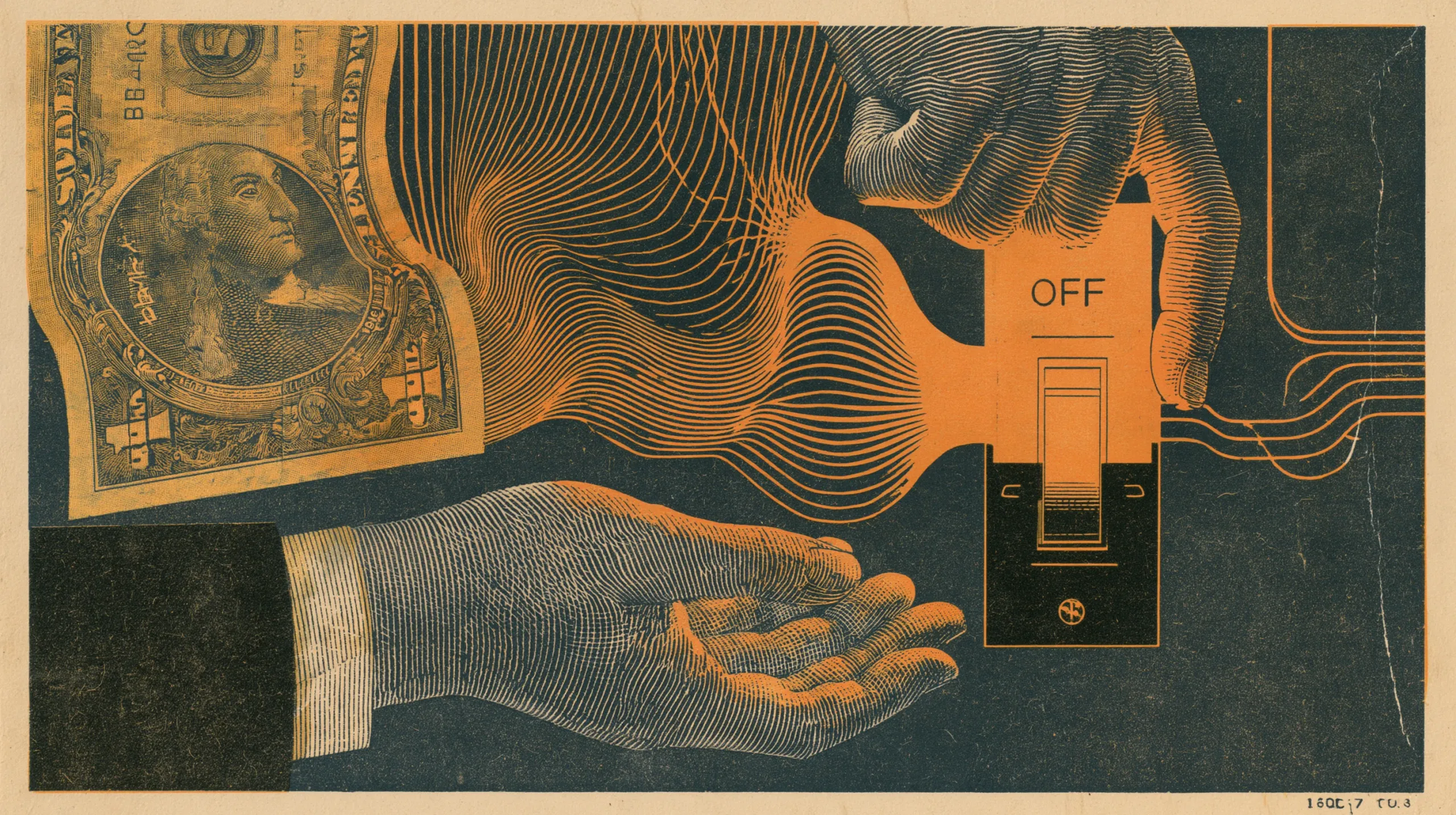
Today’s money lets the state punish you after the fact, through other people, and a lot gets missed. A central bank digital currency plus AI lets the system decide in advance, automatically and person by person, what your money will and won’t do. And nobody has to intend it. Every step toward it is a reasonable person doing their job, and a crisis is what makes the next step look obvious.
What today’s money can’t do
The pounds you spend live in two main forms.1 Notes and coins in your pocket, and deposits at a commercial bank, which are an IOU from the bank to you [the bank owes you that money and promises to pay it when you ask]. The state is at a distance from both. If it wants to freeze your account, it needs a legal order and a bank willing to act on it, one holder at a time. If it wants to stop you buying something, it passes a law and then has to catch you afterwards, through police and courts. If it wants to get money to millions of people quickly, it pushes payments through banks and waits. And if it sets interest rates below zero, you can walk to a cash machine, take out notes, and opt out. That’s a large part of why rates never went far below zero anywhere.2 Cash is a floor.
The control that exists today is slow and blunt. It needs people at every step, applies one rule to everyone, and leaks. Some of today’s friction was designed as a protection, such as the court order, and some of it is just how the system happens to work. Nobody built the second kind to protect you, and it protects you all the same. It can’t be repealed in one act, because there’s nothing to repeal. It can still drain away through many private decisions, and there’s no one you could take to court over it.
What a CBDC changes
A central bank digital currency, or CBDC, [money issued directly by the central bank, with your balance a line on its own ledger] changes the architecture of the money, while what you see on your phone stays familiar. The central bank issues the money and keeps the account your balance sits in, whoever hands you the app. And once your balance is on the issuer’s own ledger, the money itself can carry rules. That’s what programmable means [the money enforces rules about how, when, and where it can be spent, inside the payment itself].
None of this fits inside today’s money.
- Interest below zero, with no exit. The wallet can take it straight from your balance. Once cash is gone, the floor is gone. Short of that, cash falling out of everyday use doesn’t move the floor for a large holder, who can still demand notes in bulk. It does lower the floor for an ordinary saver, because each shop, branch, and cash machine that drops cash makes switching to notes dearer and more trouble. A committee can decide savers lose 4% this year, and the decision executes itself.
- Money that expires. A balance that decays unless you spend it, say 6% a year, or a stimulus payment that vanishes if unspent after a month. Today notes and bank deposits don’t have clocks in them. On a ledger, spending deadlines are a setting.
- Payments that fail at the till. Today a law says what you may not buy, and someone else has to enforce it. A shopkeeper who checks your age, a card issuer who blocks a category, or police and courts after the fact. In a CBDC the rule runs inside the transaction. That makes the rule and its enforcement one event, for every pound in the wallet. The payment for the flight, or the second tank of petrol this week, or anything outside your area in an emergency, simply doesn’t go through, with no officer, no court, and no appeal in the moment. Card payments already work that way, and a card that only works for certain things does it for every pound loaded onto the card.3 What one ledger removes is the other card, or the cash, that lets you pay anyway. What keeps the rule from reaching every pound a person holds is a limit on how much a wallet can hold and notes still being issued, and both of those are launch-day settings.
- Freezing at a keystroke. Today, freezing assets is done one holder at a time, through institutions that each have to act. On a single ledger it can be done to everyone at once. Any balance, any group of balances, instantly.
- Transfers with strings attached. Support payments that arrive tied to your digital identity, spendable only on approved categories, only by a certain date. The furlough payment, but with the conditions built into the money.
- Total visibility. Every transaction by every person, visible to the issuer in real time. Today’s system is surveilled, but the records sit in separate banks that never share one view. One ledger removes that separation.
What AI adds
The ledger gives the levers. AI supplies the hands to pull millions of them at once. Each control above still sounds like it needs an army of officials, and it doesn’t.
1.Reading
No workforce on earth could watch tens of millions of transactions a day. A model can read and score every payment in real time.4 Its scoring gets better with every flag a person confirms or rejects, because each one tells it whether that stop was right. What the flags can’t teach it is the payments it let through, because a flag only ever labels a payment it stopped. Even with that gap, on a narrow, well-defined job like this one, a model corrects the errors that it’s shown faster than any human process.
2.Personalising
Today policy is one interest rate and one rulebook for everyone, and not because anyone chose fairness. Administering different rules for each person was impossibly expensive. AI makes the running cost of per-person rules small enough to apply to every payment and to change from week to week. Where per-person rules do exist today, in tax and benefits, they’re coarse and slow, and the cost of people administering them is only part of the reason. A rule that treats one person differently also has to be justified and defended. Cheaper computing doesn’t lower the cost of justifying such a rule. A crisis does, because when preserving the money system needs a power, the laws in its way get bent or reinterpreted to fit. So your money can carry different limits from your neighbour’s, set by a model scoring your behaviour, updated continuously. And the pitch writes itself. Personalised policy means shorter recessions, targeted help, less fraud.
3.Enforcing
The rules execute without staff. People may still review the model’s flags, but that checks the model’s work, not your case. What goes is the bank clerk between the rule and your payment, the person who could have looked at it and said no, this one’s not right.
Put identity, payments, and AI in the same system and you get the end state. A person can be switched off from economic life, unable to pay or be paid, by a flag in a database. That’s already possible today where many gatekeepers act on one shared signal. What one ledger changes is that one instruction reaches every balance at once, with no other way to pay and no undoing it at one bank while it still holds at another. On the design the Bank of England has published, the central ledger holds no personal details, so turning a name into an account number stays the wallet firm’s job.5 That split is a launch-day setting. Once the ledger exists, a crisis is what makes putting identity on it tempting.
Why it arrives through the next crisis, with no villain required
Our money is debt-based. Nearly all new pounds are created when banks make loans, and those debts are fixed in pounds.6 A system loaded with debt can take a slow fall that comes with better tools. In that fall it’s the cost of making things that drops, and pay drifts down slowly behind it, so the money to meet a fixed payment is still there. What it can’t take is a sudden fall in the prices credit pushed up, houses first, because then the losses spread through the banks. So every time a sudden fall in those prices threatens, the system is rescued with new money, and the rescues keep getting bigger. In between the rescues, policy targets rising prices of about 2% a year, forever.7
AI pushes prices down harder every year, because its entire purpose is more output from less labour. So every year the system has a bigger fall in prices to cancel out, the fall that cheaper making would deliver on its own. In a downturn, when firms get squeezed, AI also cuts jobs fast. The next downturn likely arrives with a lot of people without income at once. What the record shows is that routine jobs are lost in bunches, in downturns, and don’t come back after. In the figures for the whole economy, the part that AI accounts for so far shows up as hiring that stops.8 Dismissals haven’t risen with it. At the firms that moved first, it shows up as staff numbers falling while output rises.
What do governments do then? We rehearsed the answer in the pandemic. The answer was direct payments and payment holidays, fast and to millions.9 The central banker who refuses to ease [cut rates and create new money] sees banks fail on their watch, so they ease. In a crisis the pull on the major parties is toward promising relief, so relief is what gets enacted whoever is in office. The official told to reach everyone by Friday reaches for whatever already runs, and where the records exist that’s payroll and tax files.10 Where the records don’t exist, the state opens new accounts at a bank it controls, by the million and in days. Brazil did that in 2020. Once a digital pound exists, the bank that the state controls is the central bank itself. Where the payment meets a real need, people take it, even with conditions on what it can be spent on, because the relief is immediate and certain while the cost, less freedom later, is uncertain and far off. The 2020 payments carried no such conditions.11 What they do show is how many welcomed the relief.12 Humans under stress take the certain thing. Every actor in that chain does their job reasonably, and none of them has to want the result.
The controls arrive switched off. The Bank of England’s promises about a digital pound haven’t changed. The three are no programmability by the Bank or the government, privacy protected, and cash to remain. I don’t doubt the sincerity. But those promises are launch-day settings, and settings get revisited under pressure. Once the switch exists, the next emergency finds it.
In a crisis speed beats deliberation, and the exception that the rules make for the emergency arrives labelled temporary. Emergency powers persist because the people who hold them find them useful and are rarely punished for keeping them. Where a power is propping something up, removing it also re-exposes what it was covering, which makes it harder still to give up. Each round of relief deepens the conditions the next emergency comes out of. Where the new money lands decides who gets squeezed. When it reaches banks and other investors first, it lifts house prices ahead of pay. When it’s paid into household accounts directly, it lifts the weekly shop ahead of pay. Each rescue also leaves more total debt in place, so a shock the same size as the last one needs a larger response than it needed the cycle before. Prices running ahead of pay makes people angrier, which invites spending rules and capital controls [rules that stop money moving across borders or into certain assets] to manage the anger the last round created.
A conspiracy would be a more comforting story, because you could remove the conspirators. Incentives stay when the people change.
The reasons not to worry
“Safeguards will be legislated.”
They will, and I’d still expect them to bend, because money outranks law in practice. When preserving the money system requires a power, laws get reinterpreted to fit. Emergency after emergency has bent them before. The protection that survives pressure is the one no single party can override, and it holds in proportion to how many independent parties must each agree before it can change. Nothing is impossible to override. Even a rule that many independent parties each enforce has been changed, when enough of them agreed to change it together. Written protections do sometimes bind, and sometimes in advance. So this is a claim about which kind of protection holds better under pressure.
“Banks already see everything, so nothing changes.”
Partly true, and it misses the change. Today’s surveillance is fragmented, slow, and has a cash exit. The change is architectural, with one ledger, rules executing inside the payment, and, once cash is gone, no floor under rates. Concentration is the difference.
“Personalised policy is good. Shorter recessions, targeted help.”
The relief is real, and that’s a large part of why a government reaches for such a system in a crisis. Whether people then use it has run on being made to, on what it costs them, and on whether the state pays them through it. Fear under stress is why the conditions riding along with a payment get accepted. Fear is also why paying people through it works. When the payment that people need arrives in the new wallet, many take to the wallet, because the other choice is going without. Whether per-person rules would shorten recessions is the claim of the people proposing them, and I haven’t seen it shown. But the same fine-grained control that targets help targets punishment. What decides how the control gets used is what preserving the money system requires in the next crisis, whatever the intentions of whoever is holding it. The person in the chair still makes the call, and that requirement sets the range of calls open to them. That’s why the launch-day promise isn’t the thing that governs.
The same AI running on a money nobody can expand produces the opposite world. The gains show up as falling prices, so people need less income to live. On that money the gap that a transfer has to fill gets smaller each year, because the things a household buys get cheaper. The number of people needing one can still rise as machines take more of the work. Even so, the need for transfers falls, because each payment has less to make up and falling prices cushion the workers that machines displace. The part of the state that exists to offset rising prices has less to do, so it shrinks. The conditions come with being on a payment from the state, whatever the payment’s size, so what reduces them is fewer people on one and less time spent on one.
That’s why, over time, only one of the two kinds of money can be what everyone measures in. Bridges between them run for a long while during the change, and both stay in use along the way. So this is a claim about which one ends up as the unit of account. One needs control to survive. The other removes the lever the control depends on. Which money we all stand on when the AI wave fully lands is what decides which of those two worlds we get.
Sources 12
What this essay rests on, as checked on 24 October 2026.
- 1 Bank of England, Explainer, “What is money?”, last updated 27 February 2025: “the two types used today: cash and bank deposits”; “The vast majority of money in the UK is held electronically as bank deposits, with a small proportion held in physical form as cash (banknotes and coins).”
- 2 Bank for International Settlements, BIS Quarterly Review, March 2016, “How have central banks implemented negative policy rates?”: -0.75% is the deepest rate reported (Swiss National Bank, 15 January 2015). The page says “zero has not proved to be a technically binding lower limit for central bank policy rates,” and covers five named central banks, not everywhere.
- 3 NHS Healthy Start, What you'll get and how to shop: “You should only use your card to buy certain types of milk, infant formula, fruit and vegetables.” The page instructs the holder rather than saying the card itself works only on those items. United States Department of Agriculture, Food and Nutrition Service, SNAP Retailer Notice — Allowable Items: “It is your responsibility to make sure the system is programmed correctly to accept SNAP benefits for allowable items only.” The duty falls on the retailer; the page does not say the card declines ineligible items.
- 4 Visa, Press release, 17 June 2019, “Visa Prevents Approximately $25 Billion in Fraud Using Artificial Intelligence”: “employed AI to analyze 100 percent of the transactions—each in about one millisecond”, in a release dated June 17, 2019. The page does not say how long Visa has done this. Mastercard, Press release, February 2024, “Mastercard supercharges consumer protection with gen AI”: “already helps banks score and safely approve 143 billion transactions a year”; “In less than 50 milliseconds, this technology improves the overall DI score.” The timing printed is 50 milliseconds, not about a millisecond.
- 5 Bank of England, Design note, “Intermediary roles and scheme rulebook”, 10 April 2025: "PIPs will provide the primary access to digital pound services for users." "This will include providing wallet services, initiating payments and managing user interactions with the digital pound." Bank of England and HM Treasury, Bank of England and HM Treasury respond to digital pound consultation, 25 January 2024: "The Bank and the Government would not have access to any personal data". The page states that neither the Bank nor the Government would have access to users' personal data, rather than saying what the central ledger itself holds.
- 6 Bank of England, Quarterly Bulletin 2014 Q1, “Money creation in the modern economy”, 14 March 2014: "the majority of money in the modern economy is created by commercial banks making loans."
- 7 HM Treasury, Remit for the Monetary Policy Committee and the new inflation target, December 2003: "Announced in June 2003 and implemented on 10th December 2003, the Bank of England's inflation target was redefined from 2.5 percent measured by RPIX inflation to 2 percent measured by annual CPI inflation." Federal Reserve, Statement on Longer-Run Goals and Monetary Policy Strategy, 25 January 2012: "The Committee judges that inflation at the rate of 2 percent, as measured by the annual change in the price index for personal consumption expenditures, is most consistent over the longer run with the Federal Reserve's statutory mandate." European Central Bank, An overview of the ECB's monetary policy strategy, 2021 strategy review: "at this juncture the Governing Council considers that price stability is best maintained by aiming for a two per cent inflation target over the medium term."
- 8 Brynjolfsson, Chandar and Chen, “Canaries in the Coal Mine? Six Facts about the Recent Employment Effects of Artificial Intelligence”, Stanford working paper, August 2025: "early-career workers (ages 22-25) in the most AI-exposed occupations have experienced a 13 percent relative decline in employment even after controlling for firm-level shocks". The paper reports employment, not hiring.
- 9 United States Government Accountability Office, Report GAO-20-625, “COVID-19: Opportunities to Improve Federal Response and Recovery Efforts”: “160.4 million payments worth $269.3 billion to taxpayers as of May 31”, 2020. The page prints a count of payments, not a rate of take-up.
- 10 HM Revenue and Customs, Coronavirus Job Retention Scheme statistics: 16 December 2021: “It works by providing grants to employers of up to a maximum 80% of salary to a maximum value of £2,500 per employee.” The page carries nothing on speed. HMRC, Guidance, “Claim a grant through the Self-Employment Income Support Scheme”: “submitted your 2019 to 2020 tax return on or before 2 March 2021”, “trading profits of no more than £50,000”. The page covers the fifth grant only.
- 11 United States Congress, The CARES Act, Public Law 116-136, section 2201: “$1,200 ($2,400 in the case of eligible individuals filing a joint return), plus … $500 multiplied by the number of qualifying children”. The statute gives no words saying the payments were unrestricted; it is silent on use.
- 12 HMRC, Coronavirus Job Retention Scheme statistics: August 2020, published 21 August 2020: “in total, 9.6 million employments have been furloughed through CJRS (32% of eligible employments)… with 61% of eligible employers claiming”, for claims to 31 July 2020 covering the period to 30 June 2020. National Taxpayer Advocate, Internal Revenue Service, 2020 Annual Report to Congress, “Preface: Introductory Remarks by the National Taxpayer Advocate”: “more than 160 million stimulus payments”; “most eligible individuals received their stimulus payments timely and in the correct amounts”. The page gives no take-up rate, and says millions of eligible individuals did not receive some or all of them.