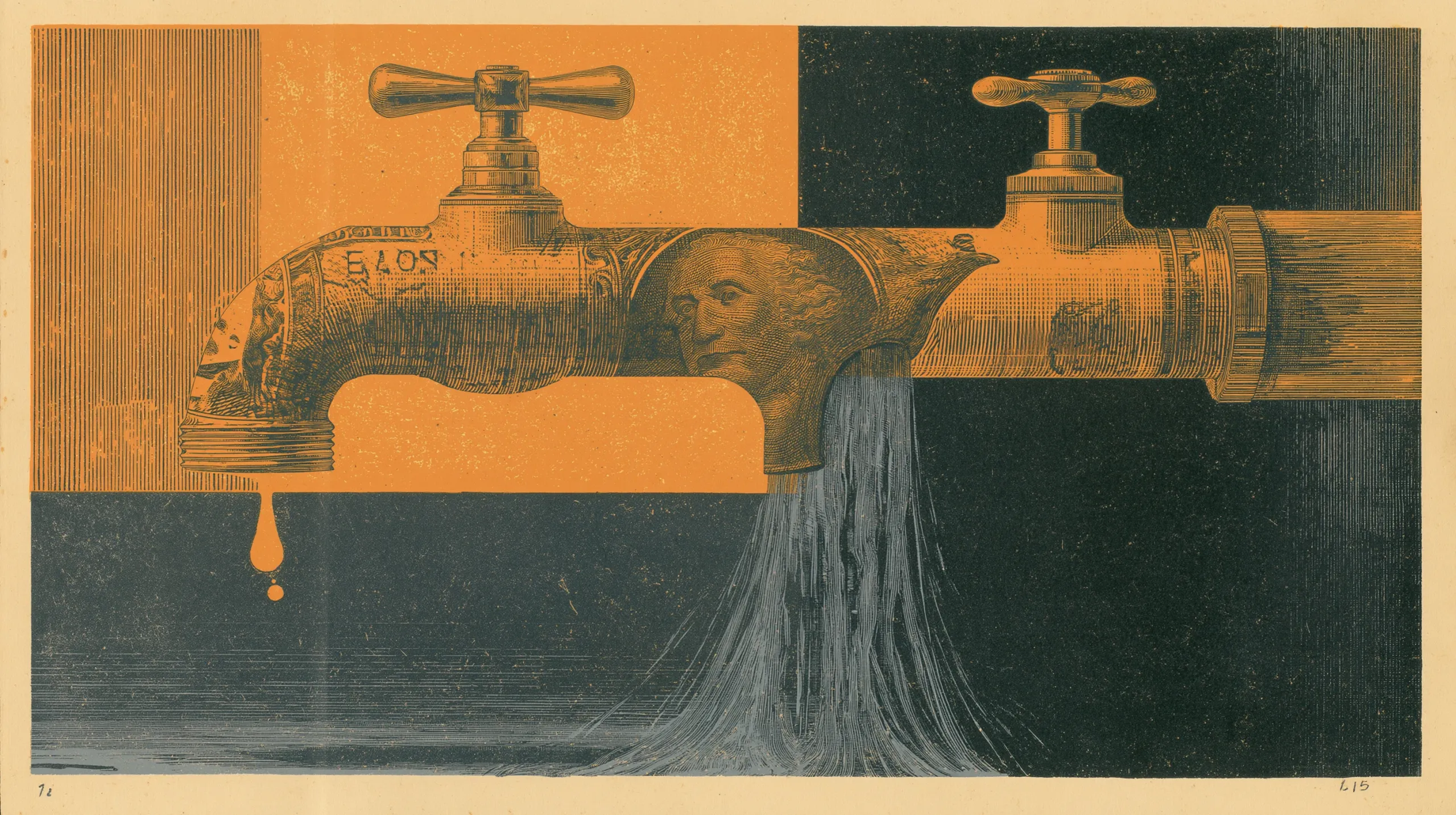
Saving in pounds no longer does what savers believe it does. You’ve seen it yourself. The safest account in the country paid 2% while lived costs rose 6%. Something is off, and the clearest way to see it is to write down the actual deal on offer. The system does make a saver a promise, and it’s a different promise from the one people think they’ve been given.
The stated promise
The Bank of England targets 2% inflation a year, and hitting that target is defined as success.1 That 2% is not a rate of interest. It is a target for how fast the pound loses value. So the official promise to anyone holding pounds is that the unit you save in will buy about 2% less every year, on purpose, forever. In twenty years, your saved £100 buys about two thirds of what it buys today. In thirty five years it buys about half. That’s the promise kept perfectly, with no crisis and no mistakes.
Then look at the interest you’re paid to accept that. Most of the time, the interest on cash savings falls short of inflation, especially after tax. When the return on the “safest” home for your money is below the rate prices rise, your loss is guaranteed in real terms, which means in what the money actually buys, not the number on the statement. That arrangement has a name, financial repression. It means holding interest rates below inflation so that debts fixed in pounds quietly shrink in real terms and savers absorb the difference. And the biggest debtor in the country is the government itself, so the biggest beneficiary of your slow loss is the borrower running the system. Even in the windows where savings interest briefly tops the official inflation number, the gain is small and tax often takes part of it. And rates that high can’t persist, because a system carrying this much debt breaks under them and policy has to retreat.
The hidden promise, which is bigger
The 2% understates the transfer, because the honest baseline isn’t zero. Technology keeps making things cheaper to produce. Better tools, better software, more automation, the same goods from fewer inputs. Under a money nobody can add to, those gains would show up as prices drifting down, which means a saver would get richer by doing nothing risky at all. That holds for everything technology has changed the making of. It doesn’t hold for housing, care, teaching, or building. So the wedge between what a saver should get and what a saver is promised is two points plus whatever prices would have fallen. If better tools would have cut prices by a point or two a year, which is about how fast output per hour of work grows on the published figures, the true gap is three or four points a year even when the target is hit, compounding against you.2 Nobody can measure the exact number, but the direction is certain. Flat prices already hide a tax on progress. Rising prices hide a bigger one.
So the full promise, spelled out as if the system said it aloud, reads, “Hold your working life in our unit. We will reduce what it buys by about 2% a year deliberately, and by more whenever the structure is stressed. We will also keep the price falls that technology would have handed you. If you want to stand still, go and take risk.”
Why it has to be this way
This isn’t a moral failure of particular central bankers. It’s structural. Nearly every pound is loaned into existence.3 A bank makes a loan by creating new money in an account, so if every loan were repaid, almost no money would be left.4 Those debts are fixed in pounds. A system built on that much debt can take a slow fall that comes with better tools. In that fall it’s the cost of making things that drops, and pay drifts down slowly behind it, so the money to meet a fixed payment is still there. What it can’t take is a sudden fall in the prices credit pushed up, houses first, because then the losses spread through the banks. In that fall it’s the lending that has stopped, so incomes and the house fall together and at once, and the fixed payment is hit from both sides in the same year. Houses come first because people buy them with borrowed money. The debt takes a bigger bite of every income. And where the loan was written against a house, the house is worth less too, so the bank stands to lose more on that loan. So every time a sudden fall in those prices threatens, the system is rescued with new money, and the rescues keep getting bigger.
In between, policy targets rising prices of about 2% a year, forever.5 Central banks publish why they aim there. They want room to cut interest rates in a downturn, they know wages resist falling, and they say the official measure of prices overstates the rise. Those are the reasons they give, and the debts aren’t among them. The debts show up in the rescues, not in the everyday 2%. Getting there takes new money that first cancels the fall better tools would have delivered, and then adds two on top. And pushing prices up is the same act as pushing down what savers’ money buys. They’re one motion seen from two sides. In this design the saver pays.
What the promise does to people
Once you see the deal, modern financial behaviour stops looking strange.
Everyone became an investor, not from greed but from necessity. When the unit leaks, standing still takes risk. A bus driver has to think like a fund manager to protect thirty years of work. The nearest thing to an exception is a government bond whose payments rise with a price index, if you buy it when it offers a return above inflation. Reaching it means lending to the government until a fixed date, often paying tax on the income, and taking whatever that index does. In 2030 the way that index is worked out changes, to a method that has given a lower number in most years.6 And the game is tilted, because new money reaches people who already own property and shares and large borrowers first and wage earners last, so the people forced to play latest start furthest behind.
Houses became savings accounts. A large slice of a house’s price is a savings premium on top of its shelter value. That’s the extra price paid because people store wealth in property when money can’t hold it. Which is also why that “safe” house is hostage to the next rate decision, because the buyers who set those prices borrowed to pay them.
And when enough of that forced risk-taking blows up at once, the largest players get rescued with newly created money. 2008 and 2020 each needed a bigger dose than the crisis before.7 Rescue after rescue runs the same transfer, and savers and wage earners are the ones who pay for it.
So, is saving pointless?
Saving is one thing. The vehicle you save in is another.
Saving, storing work you’ve already done so you can use it later, is healthy behaviour in an economy. Buffers, patience, low stress, long-term projects, all of it starts with savings. The system broke the vehicle, not the habit, and then taught everyone that the fault is theirs for saving at all.
It helps to split money’s two jobs. For spending across weeks and months, pounds still work fine, and holding cash for near-term needs makes sense in any system. The job the pound fails at, by design, is the long one, carrying value across years and decades.
And in a money nobody can add to, the natural state comes through. Technology keeps cutting what things cost to make, so savings buy more over the years, and patience is rewarded instead of taxed. You don’t need to outrun anything or become a speculator. In this framework, bitcoin is the unit where the deal inverts, as long as it stays decentralised and secure. Measured in it, the prices of many things have fallen from one halving date to the next. Those are the dates when the supply of new coins is cut in half, set by the code and not picked after the fact.8 Pick a window at random, though, and the line can run either way. Most of that fall so far is bitcoin gaining ground as a new money, a repricing that happens once. It isn’t evidence of what the deal does for someone buying after it. Over the long run, what makes the deal invert is the falling cost of making things, and that part keeps going once the repricing is done. Whether and how far you act on that is yours to decide. But saving was never the broken part.
What savers are usually told
“Without inflation nobody would spend, and the economy would stall.”
People buy things because they’re useful now. You buy a coat because you’re cold. People still queue for a new phone even though next year’s will be better. They still buy a television even though next year’s will be cheaper.9 What falling prices trim is waste. And the argument gives itself away. “Unless we take a slice of your savings each year, you won’t buy.” That’s the case for the 2%, made from the saver’s side, and it concedes this essay’s point. The target works by making your savings worth less if you hold them.
“Savers should just invest like everyone else.”
Some do well. But risk went from optional to compulsory, and the compulsory game favours whoever receives the new money first. Then, when it fails at the top, the losses are covered publicly while small failures are not. A system that punishes prudence and rescues size is teaching exactly the wrong lesson, and calling it choice.
“Wages rise with inflation, so it washes out.”
Prices move first. Pay follows later, unevenly, and the lag is where the transfer happens.10 The lost ground rarely gets made up.
“My house did my saving for me.”
In pounds, yes. But you still need somewhere to live, its taxes and upkeep rise on the same tide, and most of the gain is the money weakening rather than the house improving.11 Priced in a hard unit [a money nobody can add to], the same house has cost less and less over the last decade, though the line is jagged rather than smooth. The whole of that fall is the hard unit gaining ground. The house itself didn’t lose ground. It rose in pounds, and the hard unit rose faster.
The system’s promise to a saver is that you lose slowly, or take risk you didn’t choose. The natural promise of a productive economy is the opposite. Under a money nobody can add to, hold on and most things get cheaper.
Sources 11
What this essay rests on, as checked on 3 October 2026.
- 1 Bank of England, Inflation and the 2% target: "The Government has set us a target of keeping inflation at 2%"; "If we miss the inflation target by more than 1 percentage point either side of the target, we must tell the Government why." HM Treasury, Chancellor of the Exchequer, Letter from the Chancellor of the Exchequer to the Governor of the Bank of England, 26 November 2025: "I hereby re-confirm the inflation target as 2 per cent as measured by the 12-month increase in the Consumer Prices Index (CPI). The inflation target of 2 per cent is symmetric and applies at all times."
- 2 U.S. Bureau of Labor Statistics, series OPHNFB on FRED, Nonfarm Business Sector: Labor Productivity (Output per Hour) for All Workers (OPHNFB), index 2017=100: Annual index 2017=100: 72.455 in 2000, 86.758 in 2007, 103.636 in 2019, which is 2.6% a year 2000 to 2007 and 1.5% a year 2007 to 2019. The earlier window runs above a point or two. Office for National Statistics, UK Whole Economy: Output per hour worked, seasonally adjusted, index 2023 = 100 (series LZVB), released 18 August 2026: Index 2023=100: 92.6 in 2008, 100.0 in 2023, about 0.6% a year. That UK growth of about 0.6% a year over 2008 to 2023 is slower than a point or two a year.
- 3 Bank of England, Quarterly Bulletin 2014 Q1, “Money creation in the modern economy”, published 14 March 2014: "the majority of money in the modern economy is created by commercial banks making loans." The source says the majority of money, not nearly every pound.
- 4 Bank of England, Quarterly Bulletin 2014 Q1, “Money creation in the modern economy”, published 14 March 2014: "the majority of money in the modern economy is created by commercial banks making loans."
- 5 Federal Reserve, Statement on Longer-Run Goals and Monetary Policy Strategy, 25 January 2012: "The Committee judges that inflation at the rate of 2 percent, as measured by the annual change in the price index for personal consumption expenditures, is most consistent over the longer run with the Federal Reserve's statutory mandate." European Central Bank, Press release, “ECB's Governing Council approves its new monetary policy strategy”, 8 July 2021: "The Governing Council considers that price stability is best maintained by aiming for a 2% inflation target over the medium term." HM Treasury, Remit for the Monetary Policy Committee and the new inflation target, December 2003: "Announced in June 2003 and implemented on 10th December 2003, the Bank of England's inflation target was redefined from 2.5 percent measured by RPIX inflation to 2 percent measured by annual CPI inflation."
- 6 UK Statistics Authority and HM Treasury, Response to the joint consultation on reforming the methodology of the Retail Prices Index, 25 November 2020: "bringing the methods and data sources of the Consumer Prices Index including owner occupier housing costs (CPIH) into it"; the change to be made "in February 2030". The page prints no comparison of the two methods' levels.
- 7 United States Congress, Emergency Economic Stabilization Act of 2008, Public Law 110-343, enacted 3 October 2008: "An Act To provide authority for the Federal Government to purchase and insure certain types of troubled assets"; enacted October 3, 2008; authority to buy up to $700 billion of troubled assets. Congressional Budget Office, H.R. 748, CARES Act, Public Law 116-136, March 2020: "The CARES Act appropriates roughly $2.2 trillion of spending, tax breaks, loans, and other resources over the next decade." Act enacted March 2020.
- 8 Bitcoin Core (bitcoin/bitcoin repository), Source file src/validation.cpp, master branch: "CAmount nSubsidy = 50 * COIN; // Subsidy is cut in half every 210,000 blocks which will occur approximately every 4 years. nSubsidy >>= halvings;" The file sets the interval in blocks, roughly four years, and prints no calendar dates.
- 9 U.S. Bureau of Labor Statistics, The Economics Daily, “Long-term price trends for computers, TVs, and related items”: "The price index for TVs decreased 94 percent from December 1997 to August 2015." Nielsen, “More than Half the Homes in U.S. Have Three or More TVs”, July 2009: "in 2009 the average American home had 2.86 TV sets, which is roughly 18% higher than in 2000 (2.43 sets per home), and 43% higher than in 1990 (2.0 sets)"
- 10 International Monetary Fund, World Economic Outlook, October 2022, Chapter 2: Wage Dynamics Post–COVID-19 and Wage-Price Spiral Risks: "rising inflation, positive nominal wage growth, declining real wages, and declining unemployment characterized the macroeconomic situation in 2021 in many economies"; "wage growth has generally stayed below inflation so far"
- 11 HM Revenue and Customs, Stamp Duty Land Tax: Residential property rates, bands as at April 2025: "You usually pay Stamp Duty Land Tax (SDLT) on increasing portions of the property price when you buy residential property"; zero up to £125,000, then 2%, 5%, 10% and 12% on higher portions of the price.